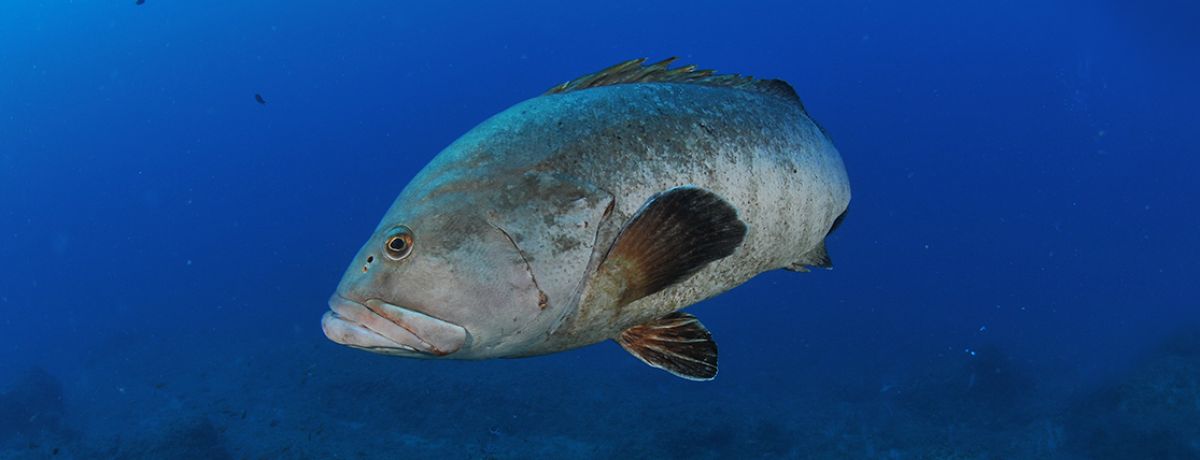
The dusky grouper (Epinephelus marginatus) is one of the Mediterranean's most iconic fish and the main focus of Project REX. It is a large predator of rocky reefs and a key species for maintaining the balance of the marine ecosystem.
Quick facts
Scientific name:
Epinephelus marginatus
Common names:
Dusky grouper, Mediterranean grouper.
Family:
Serranidae.
Conservation status:
Vulnerable (IUCN Red List).
Main threat:
Overfishing.
Distribution:
Mediterranean Sea and the eastern Atlantic Ocean.
Habitat:
Rocky reefs with caves and crevices.
Depth range:
Between 8 and 300 metres.
Size:
Up to 150 cm in length.
Biology
Reproduction
The dusky grouper is a protogynous hermaphrodite: all individuals are born female, and some change sex to become males as they mature.
Females reach sexual maturity at around five years of age, while sex change usually occurs at around ten years. The breeding season takes place during the summer.
Diet
The dusky grouper feeds mainly on:
- Fish
- Octopus
- Cephalopods
- Crustaceans
It is a patient predator, often lying in wait before ambushing its prey.
Did you know?
- All young dusky groupers are female.
- Every dusky grouper has a unique pattern of spots on its head, especially around the eyes, much like a fingerprint.
- They can live for more than 50 years.
- They are highly territorial and may remain in the same area for many years.
- They are capable of producing sounds, particularly during the breeding season.
Are dusky groupers dangerous to divers?
Dusky groupers are generally harmless to divers.
They are calm and inquisitive fish that usually tolerate the presence of divers, particularly within marine protected areas where they are accustomed to human activity.
However, like any wild animal, they may behave defensively if they feel cornered, threatened or believe that their shelter or territory is being invaded.
For this reason, it is important to observe them respectfully, keep a sensible distance and learn to recognise their body language and behaviour. When their space is respected, dusky groupers are harmless animals that offer divers a unique opportunity to observe their natural behaviour.
Diving with dusky groupers | Sustainable diving
How to observe them responsibly
- Approach slowly and avoid sudden movements to prevent startling them or disturbing their natural behaviour.
- Keep a minimum distance of 1.5 metres to respect their space and avoid making them feel threatened.
- If you wish to photograph them, keep flash use to a minimum, as repeated flashes can disturb them, particularly when sheltering in a cave or crevice.
- Do not chase them. If you remain calm and patient, they are much more likely to approach you.
- Never feed them, as this alters their natural behaviour, makes them dependent on people and can negatively affect both their health and the balance of the ecosystem. Feeding wildlife is also prohibited.
By following these guidelines, you will help preserve their natural behaviour and ensure that other divers can enjoy observing them too